
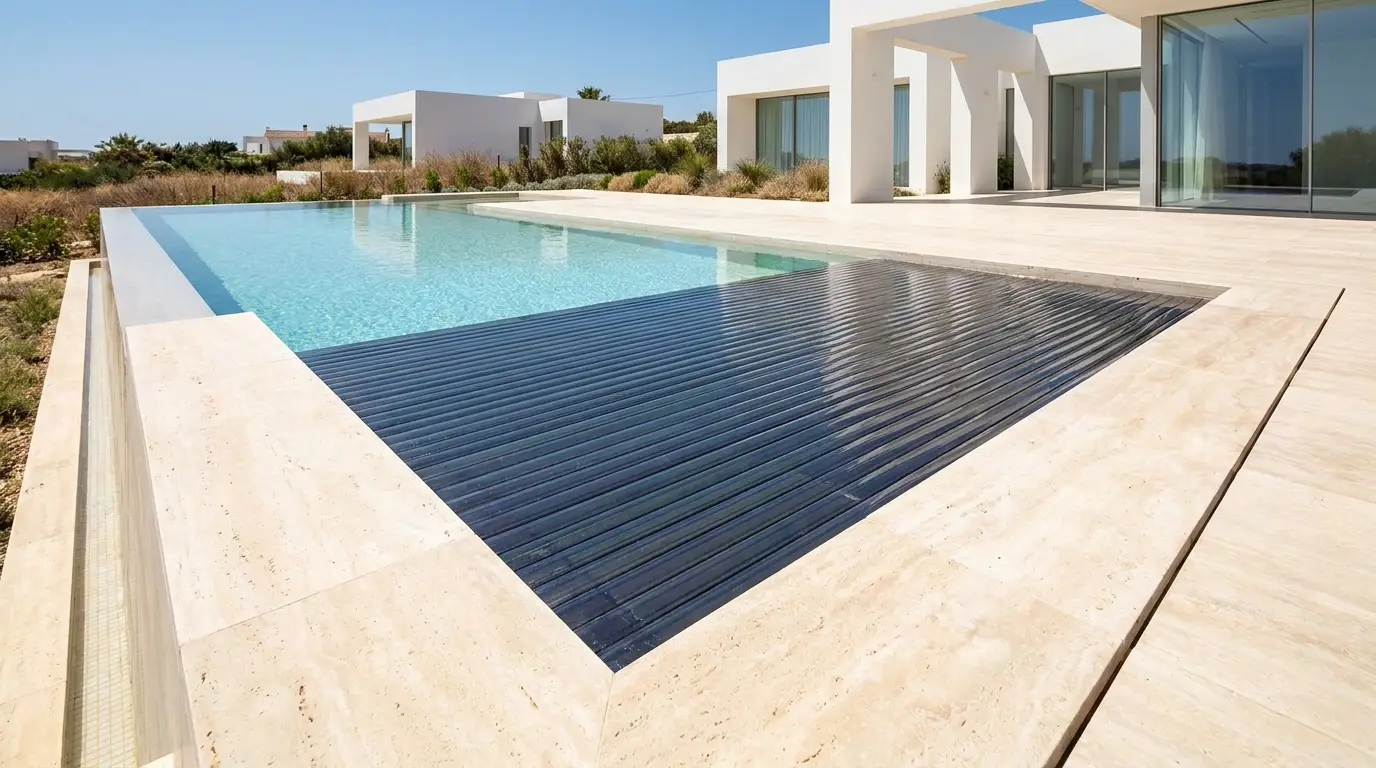
High-end automated slatted safety covers (persianas rígidas) represent one of the most significant capital upgrades for luxury villas and private estates across the Región de Murcia and Costa Blanca. These premium systems are engineered to provide absolute child safety, minimize thermal evaporation, and match modern architectural designs. However, beneath the sleek surface of these multi-thousand-euro installations, a critical mechanical and biological failure is quietly developing inside the hidden roller vault.
The Subterranean Trap of Automated Cover Cavities
Whether designed as an integrated underwater bench or an underground deck niche, the structural vault containing the motorized roller mechanism is a hydraulic blind spot. While the main pool basin enjoys continuous water movement and uniform sanitizer distribution, the hidden cover cavity experiences chronic fluid stagnation. This structural isolation creates a volatile environment where water chemistry completely breaks down, threatening the entire mechanical asset.
As the automated slatted cover retracts, it channels floating organic debris, dust, and micro-algae directly into the dark, enclosed vault. Lacking direct hydraulic circulation, this chamber transforms into an anaerobic bioreactor. Aggressive bacterial biofilms quickly colonize the stagnant depths, mutating into a resilient biological sludge that consumes local free chlorine instantly and generates intense local concentrations of corrosive organic acids.
The Double Threat of Calcification and Mineral Accretion
Compounding this biological crisis is the severe mineral profile of southeastern Spanish municipal and well water supplies. The combination of high ambient temperatures, trapped humidity within the closed vault, and extreme calcium hardness triggers rapid calcium carbonate precipitation directly onto the moving components of the cover assembly.
This mineral accretion targets the high-torque submerged motor housings, stainless steel drive shafts, and individual polycarbonate slats. As the scale layer thickens, it introduces massive mechanical friction into the drive loop, forcing the internal gearboxes to operate under chronic strain. Over a short period, this leads to structural slat warping, electronic torque-sensor faults, and total mechanical lockouts that completely disable the pool's primary safety feature.
The Incompetence of Amateur Care: Raw Acid Sprays and Mechanical Force
The premium pool maintenance market along the Mediterranean coast is heavily diluted by seasonal gardeners and uncertified handymen who treat a complex piece of electromechanical robotic engineering like a basic plastic fence. When these unqualified operators are confronted with a jammed cover or a foul odor originating from the hidden niche, their default corrective procedures are aggressively destructive.
The standard backyard "chapuza" involves pouring gallons of un-buffered hydrochloric acid directly into the stagnant vault while manually forcing the motorized roller to rotate using iron pry bars. This display of complete technical ignorance causes irreversible structural damage. The raw acid rapidly attacks the structural seals of the expensive underwater motor housing, inducing internal water ingress and catastrophic electrical short-circuits. Simultaneously, manual physical force snaps the internal polymer structural pins that lock the slats together, requiring a complete and highly expensive replacement of the entire cover matrix.
The Mechanical Disasters of Incompetent Cover Maintenance:
- Destruction of High-Torque Motor Seals: Exposing delicate internal mechanical gaskets to aggressive acid treatments, leading to terminal electronic enclosure flooding.
- Irreversible Slat Delamination: Using uncalibrated high-pressure washers too close to the hollow polycarbonate slats, punching microscopic holes that fill with water and permanently sink the cover.
- Bypassing Electronic Safety Relays: Hard-wiring around digital torque-limit sensors to force a scaled mechanism to move, burning out the central control board completely.
- Chronic Cross-Contamination of the Basin: Leaving the vault un-sanitized, allowing the hidden anaerobic sludge to continuously pollute the main pool water and double your monthly chemical consumption.
The SERVINMOSOL Engineering Protocol for Automated Cover Preservation
At SERVINMOSOL, we approach automated pool covers through the strict lens of mechanical engineering and specialized biochemical remediation. We eliminate crude physical force and destructive chemical dumping, deploying engineered solutions that restore mechanical fluidity and establish permanent biological control within your cover infrastructure.
Phase 1: Dynamic Hydraulic Niche Retrofitting
To permanently eradicate the root cause of water stagnation, our technical team re-engineers the pool's primary hydraulic return circuit. We install specialized, low-profile sub-surface directional venture nozzles directly into the interior walls of the hidden cover vault. These custom manifolds pull highly chlorinated, filtered water from the primary filtration loop and force it through the roller cave, establishing a continuous laminar flushing action that prevents organic sedimentation and ensures uniform sanitizer levels.
Phase 2: Molecular Descaling and Anti-Friction Polymer Shielding
To safely dissolve heavy calcium carbonate encrustations without endangering structural metals, we deploy advanced, biodegradable organic acid chelators combined with non-ionic surfactants. This chemical matrix safely dissolves mineral scale at a molecular level, completely clearing the slatted joints and the drive axle without scratching or pitting the underlying materials.
Following absolute descaling, we apply an industrial-grade, anti-static, hydrophobic polymer coating across the entire slatted surface. This micro-thin shield actively repels mineral bonding, lowers structural friction during rotation, and prevents organic bio-slime from gaining a physical foothold on the polycarbonate substrate, significantly extending the operational lifespan of the internal motor gears.
Phase 3: Digital Torque Loop and Electronic Recalibration
Our electrical engineers complete the protocol by executing a comprehensive diagnostic recalibration of the cover's computerized control interface. We measure the actual electrical current draw during extraction and retraction cycles using digital clamp meters. We then reprogram the variable electronic control board, setting highly precise, protective thermal and torque limits that instantly halt operation if a foreign obstruction is detected, safeguarding the structural integrity of your investment against any future mechanical overload.
Securing Real Estate Equity and Absolute Family Safety
For community presidents managing ultra-luxury urbanizations and private investors holding premium coastal estates, an automated safety cover is a critical component of the property's risk-mitigation framework and resale value. Handing the maintenance of these highly complex, motorized systems over to low-cost lawn laborers is an expensive liability that results in recurring equipment failures, ruined aesthetics, and un-compromised safety risks.
Advanced Engineering Synthesis and Expert Counsel
Ensuring the flawless operation and aesthetic execution of premium automated pool covers requires a sophisticated integration of localized hydraulic flushing, precise organic descaling, and exact electronic safety calibration. True mechanical longevity and biological purity are achieved behind the hidden roller facade, through rigorous, certified technical maintenance engineering.
Expert Advice: Never allow any maintenance provider to operate your automatic cover if the roller vault lacks an active, dedicated hydraulic circulation loop, and ban the use of raw mineral acids near your motorized drive shafts. Demand an immediate technical audit of your system's operational current draw. Contact the specialized electromechanical and luxury pool engineering division at SERVINMOSOL.COM today to implement a definitive, scientifically backed protection protocol for your high-value automated assets.