
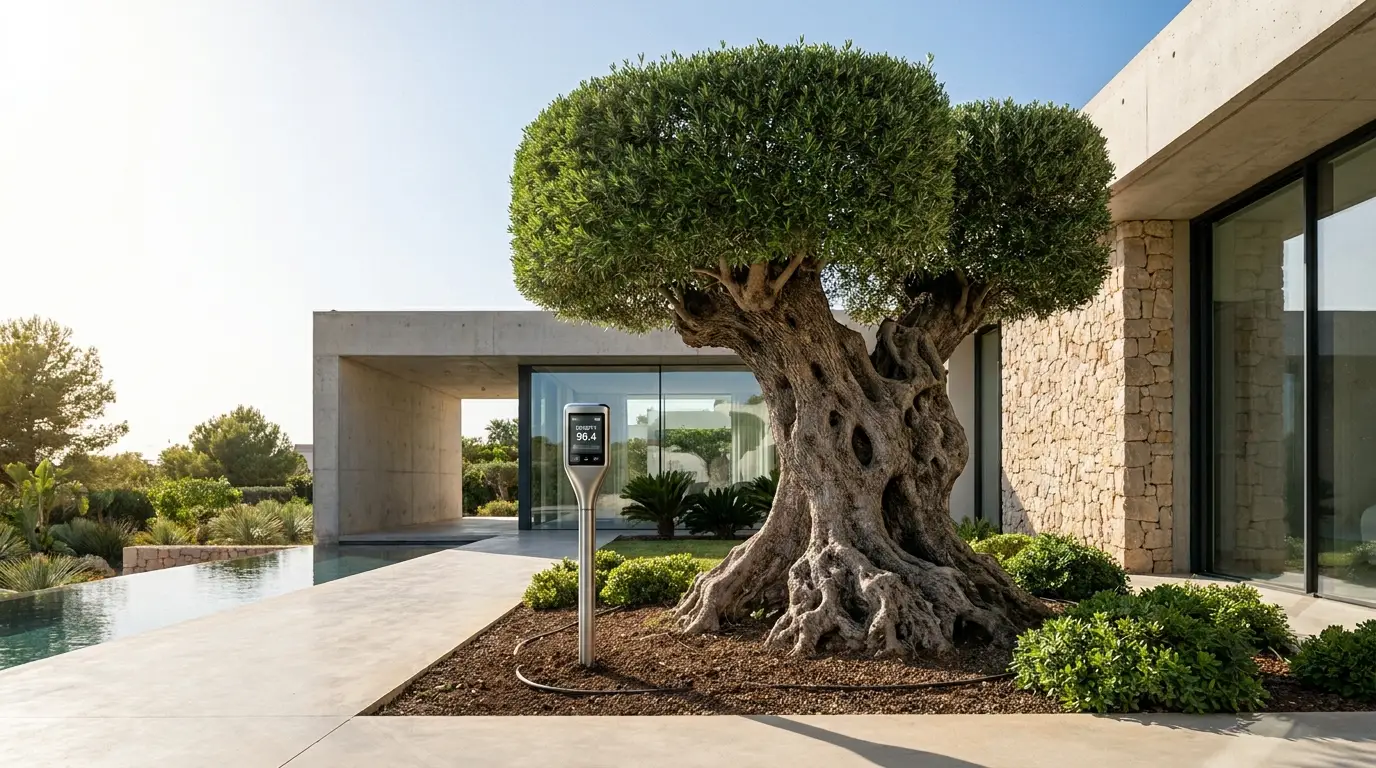
High-value coastal estates and exclusive residential communities across the Región de Murcia and Costa Blanca derive a massive portion of their capital valuation from mature specimen trees. Ancient olive trees (Olea europaea) and monumental carobs (Ceratonia siliqua) function as living historical sculptures and central architectural focal points. However, behind their majestic silhouettes, an internal structural catastrophe is unfolding across private gardens due to reckless maintenance.
The unique climate of southeastern Spain features long periods of intense, high-energy ultraviolet radiation punctuated by sudden, torrential downpours during the autumn months. While native specimen trees are evolutionarily adapted to survive these extremes, their internal biological defenses are completely compromised when their protective bark shields are mechanically breached. This opens the door to devastating internal infections.
The Pathology of Internal Heart-Rot and Lignin Degradation
When large structural limbs are severed incorrectly, the tree is unable to initiate its natural healing mechanisms rapidly enough to outrun airborne pathogens. The high humidity following torrential coastal storms creates the perfect environmental incubator for wood-decay fungi, primarily advanced strains of Basidiomycetes and polypores such as Ganoderma and Fomes. These aggressive fungi colonize the inner heartwood of the tree.
Once inside the vascular core, the fungal mycelial networks actively secrete complex enzymes that degrade lignin and cellulose, the fundamental structural polymers that give wood its mechanical strength. This biochemical digestion leads to a chronic condition known as heart-rot. The trunk slowly hollows out from the inside, significantly diminishing the tree's structural load-bearing capacity while the outer sapwood remains green and deceptive.
Because the tree's vascular cambium continues to transport water and nutrients, the foliage can appear vibrant and perfectly healthy to an untrained eye. This creates a false sense of security for community presidents and investors. In reality, the tree is becoming a dangerous mechanical liability, structurally primed to snap at the base or shed major scaffold limbs during high-velocity Mediterranean wind events.
The Failure of Amateur Chainsaw Mechanics: The Hazard of Flush Cutting
The estate management sector along the Costa Blanca is severely diluted by unqualified garden cleaners and low-cost multi-service handymen who operate heavy chainsaws without any basic comprehension of tree biology. When tasked with pruning an ancient specimen tree, these amateur operators prioritize speed over biological safety, leaving behind structural wounds that permanently doom the plant.
The standard backyard "chapuza" involves executing flush cuts, which means cutting the branch completely flat against the main trunk. This destructive practice slices directly through the branch collar, removing the specialized zone where the tree concentrates its natural chemical defense barriers. By destroying this natural barrier, the amateur gardener permits fungal mycelium to move unimpeded into the main trunk column.
The Trap of Toxic Pruning Sealants:
- Moisture Trapping Polymeric Paints: Amateurs routinely slather wounds with cheap plastic tar or synthetic sealants, which crack under UV exposure and trap ambient humidity beneath the paint coating, accelerating fungal growth.
- Un-Sanitized Heavy Machinery: Moving from a disease-ridden estate to a luxury villa without sterilizing chainsaw bars, transferring lethal fungal spores directly into healthy heartwood tissue.
- Radical Canopy Topping: Severing major upward limbs to reduce tree height, which shocks the root network and induces massive tissue dieback along the entire trunk profile.
- Neglecting Structural Physics: Leaving heavy, asymmetric secondary branches on a hollowed trunk, which unbalances the mechanical center of gravity and guarantees future splitting.
The SERVINMOSOL Engineering Protocol for Advanced Arboricultural Preservation
At SERVINMOSOL, we treat monumental specimen trees as historical living architecture that requires rigorous biomechanical analysis and precise surgical execution. We completely reject basic cosmetic hacking. Our advanced arboricultural division implements non-destructive diagnostic testing and structural physics to stabilize and protect your high-value green infrastructure.
Acoustic Tomography and Non-Destructive Cavity Mapping
To determine the exact structural integrity of a compromised trunk without causing additional trauma, our technical team deploys advanced sonic and electronic tomography (PiCUS). By placing a ring of non-invasive sensors around the tree's perimeter and inducing sound waves, we measure the precise internal density of the wood. This digital system generates a multi-colored cross-sectional map revealing the exact location, shape, and percentage of internal heart-rot and hollow cavities.
Implementation of Shigo's CODIT Pruning Parameters
When executing essential canopy maintenance, our certified arborists operate strictly according to Shigo's principles of Compartmentalization of Decay in Trees (CODIT). We prune exactly outside the branch bark ridge and branch collar, preserving the tree's natural chemical walling zones. This allows the tree to rapidly develop a clean callus layer of woundwood, naturally sealing out airborne pathogens without the need for artificial, toxic sealants.
Dynamic Synthetic Crown Support Systems
Instead of installing ugly, rigid iron braces that restrict natural movement and cause structural stress fractures, SERVINMOSOL engineers custom dynamic crown cabling systems. Utilizing high-tensile, UV-stabilized hollow rope matrices, we interconnect weak structural limbs. This design permits the tree to swing naturally in low winds, promoting healthy wood development, while engaging structural support during severe storms to prevent mechanical snapping.
Biomechanical Asset Protection for Premium Landscapes
A century-old olive or carob tree is an irreplaceable luxury asset that can take multiple generations to mature, adding immense prestige and financial value to a property portfolio. Entrusting these prehistoric living monuments to low-cost lawn laborers using dirty chainsaws is a critical risk that leads to structural collapse, legal liabilities from falling limbs, and catastrophic asset depreciation.
Conclusion and Technical Directive
Preserving the structural integrity and biological lifespan of premium monumental trees requires absolute alignment with advanced forest pathology, precision acoustic diagnostics, and non-destructive mechanical stabilization. Tree longevity and storm resilience are achieved inside the timber matrix, through calculated arboricultural engineering.
Expert Advice: Never permit any contractor to remove large limbs from your specimen trees without first demanding a non-destructive sonic tomography assessment and a certified arborist's mechanical risk report. Proactive vascular protection is infinitely cheaper than attempting to structurally brace a fully collapsed trunk. Contact the engineering and advanced arboricultural division at SERVINMOSOL.COM today to secure a scientific preservation program for your estate's oldest living investments.