
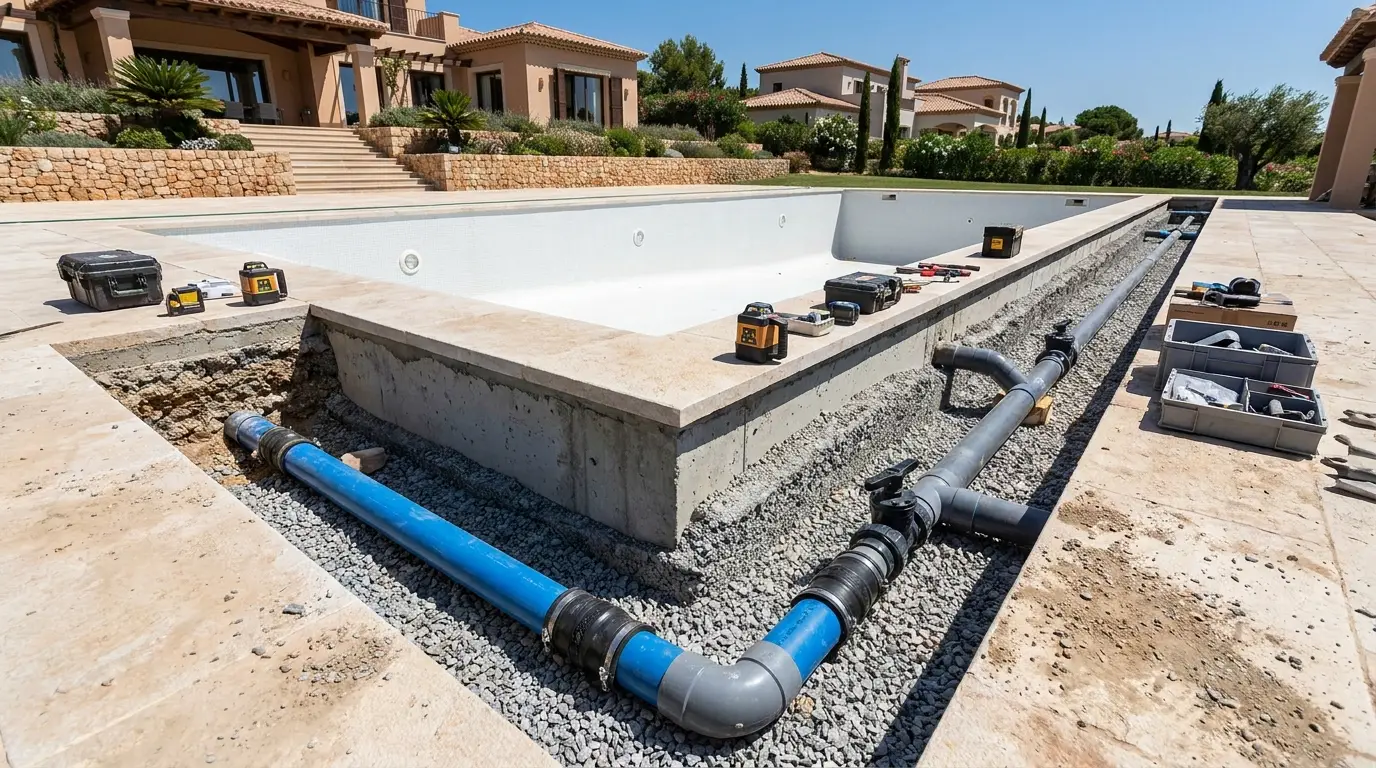
Discovering a rapid and unexplained drop in your pool's water level is one of the most stressful events for any luxury property owner on the Costa Blanca or in the Region of Murcia. Expatriate investors and community presidents immediately fear the worst: a catastrophic structural crack in the concrete basin. However, the concrete shell is rarely the actual point of failure. The true culprit is almost always hidden underground, buried beneath the expensive porcelain decking.
The most pervasive and structurally devastating cause of massive water loss in Spanish coastal properties is a geotechnical phenomenon known as subterranean pipe shear. This occurs when the rigid PVC hydraulic lines connecting your skimmers, main drains, and return jets are physically snapped off at the exact point they exit the exterior concrete wall. Understanding the mechanics of this failure is critical to permanently protecting your real estate investment.
The Geotechnical Threat of Expansive Clays
To accurately diagnose pipe shear, we must first examine the specific geology of the Spanish Levant. The coastal plains of Alicante and the Mar Menor basin are heavily composed of smectite and expansive clay soils. These specific soil types are highly reactive to the extreme Mediterranean climate, absorbing massive amounts of moisture during the torrential autumnal "Gota Fría" rains and shrinking dramatically during the scorching summer droughts.
This severe shrink-swell cycle creates constant, powerful vertical and lateral ground movement. When a luxury pool is constructed, the concrete basin acts as a massive, rigid monolith floating within this shifting earth. However, the surrounding backfilled soil—where all the critical plumbing infrastructure is buried—is in a state of continuous geological motion, shifting up and down by several centimeters every single year.
Because standard Spanish pool builders frequently cast the rigid PVC pressure lines directly into the concrete shell without any flexible sleeving, these pipes become trapped. When the surrounding earth inevitably settles or expands, the tremendous weight of the soil pulls forcefully downward on the plumbing. The pipe acts as a mechanical lever against the unyielding concrete wall, inevitably shearing and snapping at the most vulnerable junction.
Diagnosing Hydraulic Encapsulation Failure
Identifying this highly specific failure requires precise observation before any invasive excavation begins. The most classic symptom of a severed skimmer throat is the "water line drop test." If your pool loses water rapidly but mysteriously stops leaking the exact moment the water level falls just beneath the mouth of the skimmers, the fracture is undeniably located on the skimmer suction line.
Conversely, if the water continues to drop past the skimmers and only stabilizes when it reaches the level of the return jets, you are facing a deep-water return line shear. In high-end properties equipped with automated electronic water leveling systems, this massive leak can remain completely hidden for months. The only indicator will be an astronomical municipal water bill and a sudden, uncontrollable spike in chemical consumption.
SERVINMOSOL strictly warns against the local "chapuza" of attempting to seal a sheared subterranean pipe by blindly injecting expanding polyurethane foam or underwater epoxy putty directly into the skimmer throat. These amateur, cheap fixes are entirely static solutions applied to a highly dynamic geological problem. They will inevitably fail within weeks under the continuous shear stress of the moving earth, entirely wasting your maintenance budget.
The Destructive Feedback Loop of Leaking Water
Ignoring a sheared pipe, or applying a temporary patch, triggers a devastating geotechnical feedback loop beneath your luxury terrace. As hundreds of liters of chlorinated water pour directly into the surrounding backfill every day, the local expansive clays become permanently super-saturated. This artificial localized flooding causes the soil immediately beneath your perimeter decking to lose all its structural bearing capacity.
The pressurized water aggressively washes away the fine substrate supporting the coping stones (coronación). Within a few months, you will visually observe the heavy marble or porcelain perimeter tiles beginning to tilt inward toward the water, creating a highly dangerous tripping hazard. If the leak is severe enough, the super-saturated soil can even cause the entire concrete pool shell to begin subsiding on one side.
Advanced Diagnostics and Precision Engineering
At SERVINMOSOL, our lead hydraulic engineers never guess the location of a subterranean leak. We deploy military-grade pneumatic pressure testing protocols to individually isolate every single hydraulic circuit in the plant room. By injecting highly compressed air and specialized tracer gases into the lines, we can mathematically verify which specific pipe has suffered a shear failure.
Once the circuit is isolated, we utilize advanced acoustic ground microphones and thermal imaging cameras to pinpoint the exact location of the subterranean fracture beneath the terrace. This advanced technological approach allows us to execute surgical, highly localized excavations, saving our clients thousands of euros in unnecessary deck demolition and landscape destruction.
Technical Remediation and Hydraulic Decoupling
True engineering remediation requires far more than just gluing a new piece of rigid PVC pipe onto the broken stub. Our objective is to permanently immune the pool's infrastructure from future soil settlement. We achieve this by implementing a rigorous protocol known as total hydraulic decoupling, which completely isolates the plumbing from the shifting earth.
- Geotechnical Sub-base Replacement: We meticulously excavate the saturated, unstable clay from the trench and permanently replace it with angular, self-compacting crushed gravel, which provides a non-expansive, perfectly draining structural bed for the new pipes.
- Heavy-Duty Flexible Couplings: We install industrial-grade, wire-reinforced flexible PVC sections at the immediate exit point of the concrete shell. These engineered joints act as hydraulic shock absorbers, safely flexing with any future ground movement.
- Protective Conduit Sleeving: All new primary pressure lines are entirely encased within a secondary, oversized corrugated protective conduit, physically preventing the weight of the backfilled earth from ever resting directly on the water-bearing pipe.
- Chemical Resin Anchoring: To protect the structural integrity of the terrace, we inject high-strength, hydro-expansive chemical resins into the voids beneath the coping stones, permanently re-stabilizing the perimeter decking without requiring a full surface rebuild.
Conclusion
A catastrophic loss of water in your Mediterranean pool is a severe engineering emergency, but it does not necessarily spell the structural death of your concrete basin. By thoroughly understanding the volatile geotechnical dynamics of the Murcian and Alicantino coastlines, property owners can accurately diagnose subterranean pipe shear and firmly reject temporary, amateur repairs.
Expert Advice from SERVINMOSOL: If your automated chemical dosing system is running out of liquid chlorine or acid twice as fast as usual, turn off your automatic water top-up valve immediately and monitor the surface level for twenty-four hours. Uncovering a hidden pipe shear early is the only way to prevent the leaking water from permanently destroying the structural foundation of your luxury perimeter decking.