
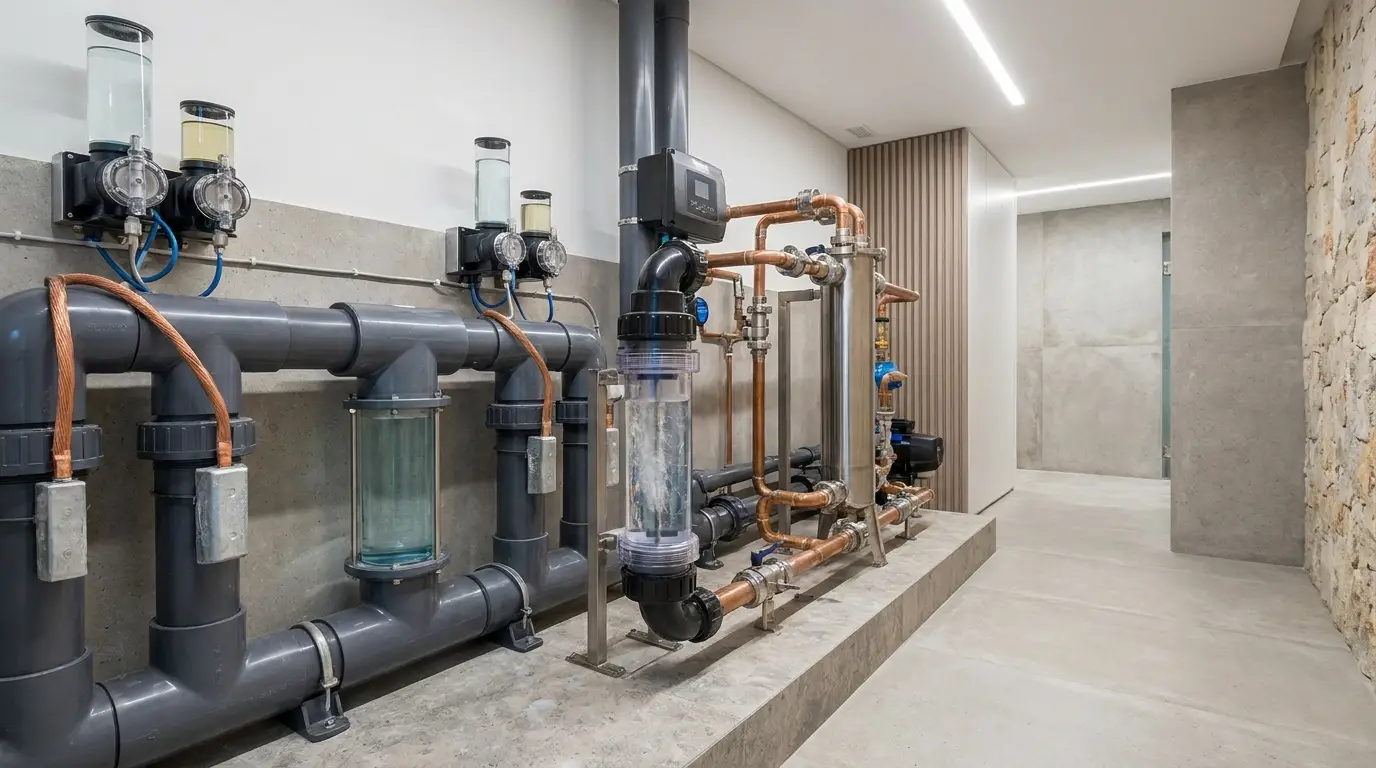
The transition to saltwater chlorination is heavily marketed as a health-conscious, low-maintenance upgrade for luxury villas and large residential communities across the Región de Murcia and the Costa Blanca. However, beneath the surface of this eco-friendly promise lies a destructive electrochemical reality. When installed by unqualified personnel, these systems frequently trigger severe structural and mechanical degradation.
The Silent Destroyer of Luxury Pools: Electrolysis and Saturation Imbalance
When salt is introduced to pool water, the electrolytic cell passes an electric current through the solution to generate free chlorine. This process fundamentally alters the electrical conductivity of the water matrix. In the hyper-arid, high-temperature climates of Alicante and Murcia, municipal supply water already carries an incredibly high baseline of Total Dissolved Solids (TDS) and heavy calcium hardness.
Introducing high-voltage electrolysis into this specific chemical profile creates a volatile environment. Without advanced mitigation, stray electrical currents target the weakest metallic components in the hydraulic loop. This leads to rapid, systemic failure that standard pool handymen are entirely unequipped to diagnose or resolve.
Galvanic Corrosion: The Electrochemical Attack on Pool Metalwork
Because saltwater acts as a highly efficient electrolyte, it drastically accelerates galvanic corrosion. When dissimilar metals exist within the pool infrastructure, an accidental battery is created. Stray electrical currents originating from poorly insulated pool pumps, heat pumps, or underwater lighting niches travel through the water column looking for a path to the ground.
Components manufactured from high-grade AISI-316 stainless steel, such as premium entry ladders, built-in water features, filter internal assemblies, and titanium heat exchangers, quickly become sacrificial victims. The results are devastating: deep structural pitting, severe structural rusting, and premature component failure within just two to three seasons of operation.
The LSI Scaling Crisis: How Alkaline Spikes Destroy Electrolytic Cells
The secondary byproduct of electrolysis at the cell's cathode is sodium hydroxide, a highly alkaline compound that causes pool water pH to spike rapidly and continuously. In the inherently hard water regions of southeastern Spain, this unmanaged alkalinity completely destabilizes the Langelier Saturation Index (LSI), which measures the exact calcium carbonate saturation of water.
When the LSI shifts into a chronic positive state, calcium carbonate immediately precipitates out of solution. This creates a thick, rock-hard calcified crust directly onto the internal titanium plates of the chlorinator cell. The scale acts as an electrical insulator, forcing the power supply to overwork, dropping chlorine production to zero, and destroying the expensive cell matrix prematurely.
The Backyard "Chapuza": Why Uncertified Installers Ruin Salt Systems
The Mediterranean pool market is heavily oversaturated by seasonal handymen and cut-price contractors who treat a saltwater conversion as a basic plumbing task. They simply glue the electrolytic cell into the return pipe, wire it directly into the filtration clock, and walk away. This absolute lack of technical expertise is a financial disaster for property owners.
These unqualified installers consistently omit the mandatory electrical and chemical engineering safeguards required to manage an active electrochemical reactor. Their complete ignorance regarding dynamic water chemistry and electrical bonding leaves your high-value real estate asset completely unprotected against systemic decay.
The Catastrophic Failures of Incompetent Installations:
- Omission of Sacrificial Zinc Anodes: Amateurs never install inline zinc bonds to intercept and absorb stray electrical currents before they attack stainless steel assets.
- Absence of Equipotential Bonding: They fail to connect all metallic components, structural pool rebar, and equipment grounds into a singular, unified earth loop.
- Lack of Automated Acid Regulation: Relying on manual acid dosing to counter the daily alkaline output of a salt cell guarantees volatile pH swings and intense scaling.
- Blind Chemistry Management: They ignore LSI scaling thresholds entirely, relying on primitive, inaccurate test strips that cannot measure cyanuric acid or calcium balance accurately.
The SERVINMOSOL Engineering Protocol for High-Performance Salt Systems
At SERVINMOSOL, we approach saltwater chlorination through the strict lens of industrial chemical and electrical engineering. We don't just install equipment; we engineer a balanced, closed-loop hydraulic ecosystem designed to operate flawlessly for decades without degrading your infrastructure.
1. Equipotential Grounding Matrix and Sacrificial Protection
To absolute eliminate galvanic corrosion, our technical team establishes a comprehensive equipotential bonding network. We tie every metallic element in contact with the water into an independent, low-resistance earth ground rod. Furthermore, we integrate a heavy-duty, inline sacrificial zinc anode (inline zinc bond) directly into the filtration manifold, ensuring all stray currents safely degrade the replaceable zinc rather than your premium stainless steel fixtures.
2. Proactive LSI Microprocessor Automation
We mitigate the threat of calcium scaling by deploying commercial-grade, digital control loops. Our installations utilize high-precision, real-time glass electrodes coupled with peristaltic dosing pumps running advanced algorithm software. These systems continuously calculate the water's real-time LSI based on temperature, total alkalinity, and calcium hardness, injecting precise micro-doses of liquefied pool acid to lock the water into a perfectly neutral, non-scaling, non-corrosive state.
3. Hydrodynamic Flow Optimization
To prevent gas pockets and localized thermal scaling inside the electrolytic chamber, we recalibrate the pool's hydrodynamics. By integrating high-efficiency variable-speed pumps, we establish a continuous, calculated laminar flow rate across the titanium plates. This completely prevents localized chemical stagnation, drops energy consumption by up to seventy percent, and ensures optimal chlorine gas dissolution throughout the entire pool volume.
Securing the Lifespan of Your Hydraulic Infrastructure
For community presidents managing massive multi-property pools and investors holding high-end coastal villas, a corroded filtration system or a scaled-out salt cell represents an unacceptable capital expense. Entrusting these sophisticated systems to low-cost maintenance laborers is an expensive mistake that results in recurring component replacements and failed health inspections.
Conclusion and Technical Directive
Operating a successful, high-efficiency saltwater pool in the demanding climate of Murcia and the Costa Blanca requires rigorous engineering control over electrical potential and calcium saturation indices. True system longevity is only achieved when electrical grounding and automated chemical balance are executed with mathematical precision.
Expert Advice: Never allow a contractor to install a saltwater chlorinator without verifying they are executing an independent equipotential earth bond and installing a dedicated inline sacrificial anode. Demand an architectural diagnostic review of your filtration room chemistry. Contact the engineering and advanced pool division at SERVINMOSOL.COM today to secure a definitive, technically flawless saltwater conversion for your premium property.