
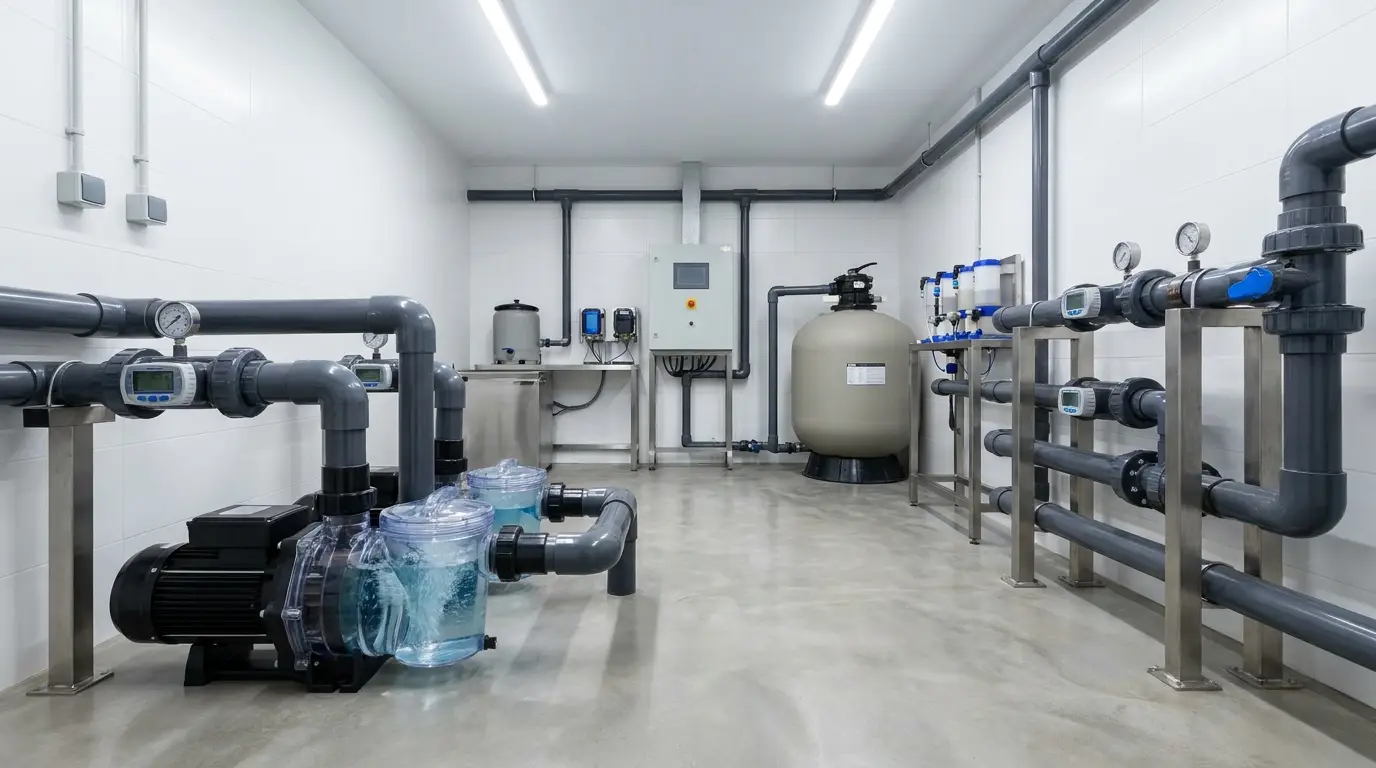
The integration of intelligent, variable speed pumps (VSPs) is widely regarded as the gold standard for mechanical modernization and energy reduction across elite developments in the Región de Murcia and Costa Blanca. Property investors and community presidents are frequently persuaded to purchase these top-tier motors to slash electrical overheads and achieve whisper-quiet filtration. Yet, a silent, destructive mechanical phenomenon is currently destroying these high-value upgrades within pump rooms throughout Alicante and Torrevieja.
This widespread operational failure is not a manufacturing defect or an electrical supply issue. It is a fundamental hydrodynamic crisis born from a severe mathematical mismatch between high-efficiency motor outputs and obsolete, uncalibrated subterranean pipe networks. When advanced smart pumps are installed without precise fluid dynamics calculations, they trigger severe internal hydraulic destruction that standard maintenance handymen are completely unqualified to diagnose or resolve.
The Mechanics of Fluid Resistance: Total Dynamic Head Mismatches
To understand why a premium variable speed pump fails prematurely, one must examine the physical laws governing fluid motion within a closed circuit. Every swimming pool plumbing system exerts a specific layout resistance against water flow, mathematically defined as Total Dynamic Head (TDH). TDH represents the sum of net elevation changes, friction losses caused by the internal roughness of PVC pipes, and restriction losses introduced by valves, heaters, filters, and sharp bends.
When a high-performance motor is retrofitted into an existing system, its integrated variable frequency drive (VFD) allows it to alter water flow rates exponentially. However, if the existing plumbing architecture possesses an uncalculated, excessively high TDH, the pump is forced to operate outside its engineered performance curve. This mismatch disrupts the laminar flow of water, generating massive turbulent vortexes inside the suction manifold and initiating the destructive process of cavitation.
The Physics of Internal Impeller Cavitation and Vapor Implosions
Cavitation occurs when the fluid velocity at the pump intake becomes excessively high due to a restricted or undersized suction pipe. According to Bernoulli's principle, this velocity spike causes a localized, drastic drop in fluid pressure. If this localized pressure drops below the absolute vapor pressure of the pool water, the liquid instantly boils, transforming into millions of microscopic vapor bubbles within the low-pressure zone directly at the eye of the rotating impeller.
As these vapor bubbles are swept along the impeller blades into the high-pressure zones of the pump volute, they instantly collapse. These are not gentle pops; they are violent, supersonic micro-implosions that generate localized shockwaves exerting pressures up to 10,000 bars and temperatures reaching thousands of degrees Celsius at the molecular level. This continuous kinetic bombardment physically eats away at the impeller material, causing severe pitting, structural balance degradation, mechanical seal failure, and total motor burnout.
The Blind Upgrade "Chapuza": Why Traditional Installers Destroy Smart Pumps
The swimming pool maintenance sector along the Mediterranean coast suffers from severe professional intrusion, where basic garden cleaners and uncertified multi-service handymen market themselves as hydraulic technicians. When tasked with installing an expensive variable speed pump, their unscientific approach consists entirely of gluing the new motor onto the old pipe joints, wiring it up, and ramping the speed setting to maximum to show off a high-pressure water return.
This absolute lack of technical training is a financial catastrophe for property owners. These unqualified installers possess no comprehension of pipe fluid velocity limits or Reynolds numbers. By forcing a high-volume smart pump to draw water through restrictive, primitive plumbing systems, they turn an expensive piece of energy-saving machinery into an active self-destructing mechanism that increases community energy usage and destroys the internal components of the filtration loop.
The Systemic Blind Spots of Incompetent Mechanical Installations:
- Omission of Suction-Side Straight Pipe Parameters: Amateurs routinely place a sharp 90-degree elbow directly into the pump suction inlet, inducing severe fluid turbulence and asymmetric impeller loading.
- Exceeding Maximum Fluid Velocity Thresholds: Forcing water velocities to surpass the strict engineering limits of 1.5 meters per second on suction lines and 2.2 meters per second on return lines, causing massive friction drag.
- Filter Over-Pressurization and Media Channeling: Mismatching pump flow capacity with the physical surface area of the sand filter, forcing raw water through the media so quickly that filtration performance drops to zero.
- Zero Calibration of Custom VFD Speed Profiles: Leaving the smart pump running on factory default high-RPM profiles, completely defeating the economic purpose of the variable speed upgrade and accelerating bearing wear.
The SERVINMOSOL Protocol for Hydrodynamic Calibration and Fluid Optimization
At SERVINMOSOL, we treat your pool mechanical room as an industrial hydraulic facility demanding absolute mathematical precision. We don't guess flow rates or install uncalibrated hardware. Our specialized pool engineering division utilizes fluid dynamics modeling and advanced flow metrics to ensure your filtration loop operates at peak thermal and mechanical efficiency.
Phase 1: Diagnostic TDH Calculation and Vacuum Profile Mapping
Before any equipment selection occurs, our technical engineers execute a comprehensive hydraulic audit of your existing infrastructure. We install digital vacuum and pressure gauges directly into the suction and discharge lines to chart the real-time operational curve of the plumbing matrix. By calculating the exact Total Dynamic Head across all operating modes, we pinpoint hidden friction bottlenecks and determine the precise safe flow envelope of the property.
Phase 2: Laser-Guided Manifold Re-Engineering and Swept-Elbow Integration
To eliminate cavitation-inducing turbulence, our master technicians strip away restrictive, undersized pipe clusters. We rebuild the suction and discharge manifolds utilizing heavy-duty, high-pressure 63mm or 75mm Schedule 40 PVC plumbing. We strictly enforce the five-times-diameter straight pipe rule directly prior to the pump intake and replace all sharp 90-degree fittings with sweeping 45-degree bends or gradual radius turns, transforming turbulent fluid chaos into smooth, effortless laminar flow.
Phase 3: Microprocessor-Controlled Flow Balancing and Filtration Optimization
Once the hydraulic architecture is physically optimized, we execute a digital calibration of the variable speed pump's onboard microprocessor. We program custom, multi-stage frequency steps tailored specifically to your pool's volume and the physical surface dynamics of your filtration media. By setting a low-RPM continuous circulation cycle, we maximize water contact time with the activated glass media, drop filtration velocity down to an optimal 30 cubic meters per hour per square meter, and slash system electrical consumption by up to eighty percent.
Securing Mechanical Capital and Reducing Community Overhead Costs
For community presidents managing massive multi-property shared facilities and private investors holding premium luxury real estate portfolios, the mechanical pump room represents the literal heart of the property's aquatic valuation. Entrusting these highly sophisticated variable speed systems to uncertified low-cost contractors is a critical financial risk that results in premature equipment replacements, ongoing noise complaints from residents, and inflated community electricity bills.
Hydrodynamic Synthesis and Executive Technical Mandate
Achieving the massive financial savings and silent operation promised by modern variable speed pumps requires strict adherence to fluid dynamics, precise pipe sizing ratios, and exact Total Dynamic Head balancing. True mechanical efficiency and component longevity are never achieved by simply buying a premium brand; they are engineered behind the pump room doors through scientific hydraulic execution.
Expert Advice: Never allow a technician to install a variable speed pump without demanding a written calculation of your system's Total Dynamic Head and a digital flow-meter calibration of the custom RPM speed steps. Cheap, uncalibrated installations will destroy your mechanical assets from the inside out via cavitation. Contact the advanced hydraulic engineering and mechanical pool division at SERVINMOSOL.COM today to book an exhaustive hydrodynamic audit of your luxury filtration systems.