
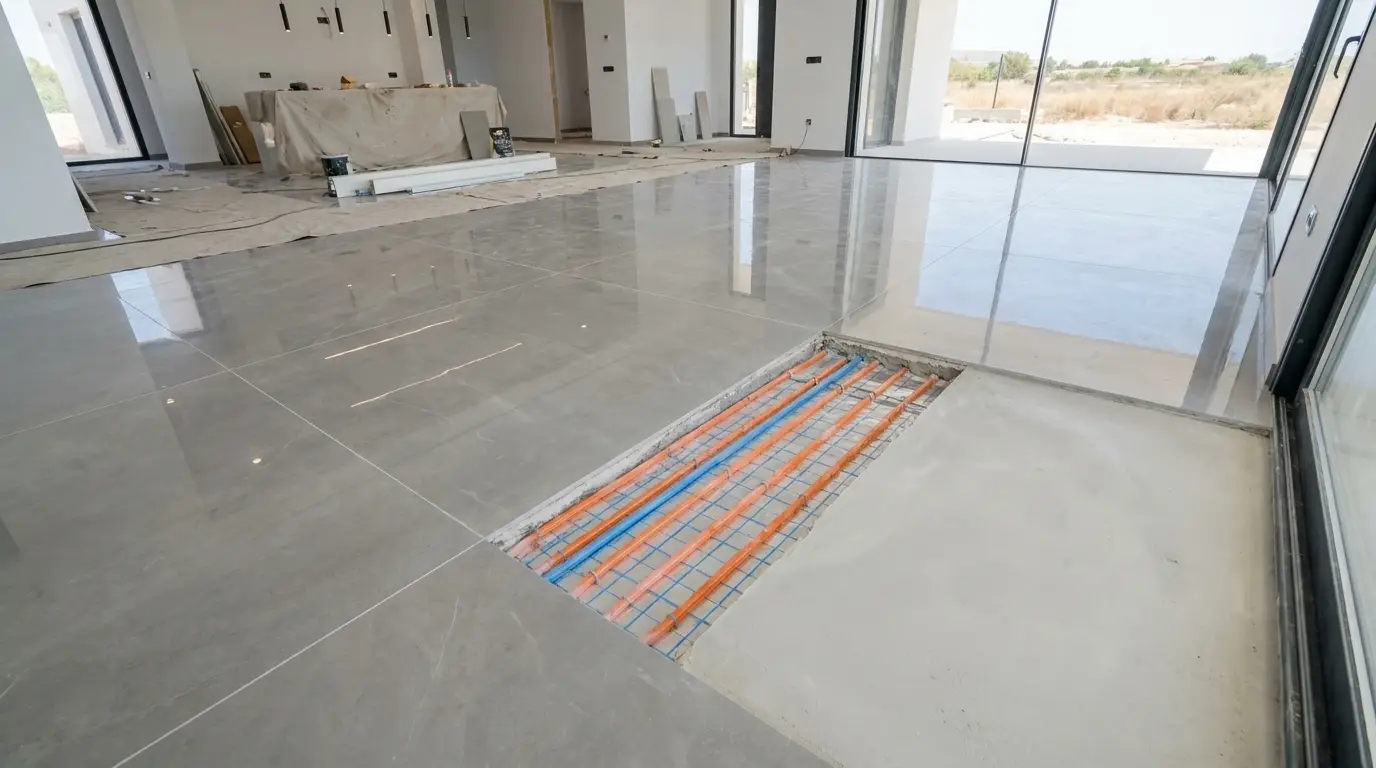
High-end villa renovations along the Costa Blanca and the Región de Murcia are currently dominated by two parallel architectural trends: the installation of hyper-modern aerothermal underfloor climate systems and the seamless layout of ultra-large format premium porcelain slabs. While this combination offers unparalleled thermal comfort and minimalist aesthetics, it represents a volatile engineering challenge. Without rigorous material science calculation, this expensive investment frequently undergoes total structural failure.
The Biophysics of Floor Tenting and Adhesion Shear Failures
When integrating hydronic heating and cooling lines beneath large-format tiles ($120 \times 120\text{ cm}$ or greater), the floor assembly functions as a dynamic thermodynamic sandwich. The sudden temperature fluctuations generated by high-efficiency inverter heat pumps cause continuous, micro-metrical expansion and contraction cycles within the substrate. Standard concrete slabs and cheap mortars cannot absorb these multidirectional physical stresses.
If the installation is executed improperly, the resulting shear stress forces exceed the mechanical tensile strength of the adhesive bond. This leads to the phenomenon known as floor tenting, where tiles abruptly buckle, fracture, or completely detach from the ground. Furthermore, sub-surface expansion forces degrade the adjacent acoustic insulation bands, causing systemic hollow sounds across the property.
The Breakdown of Amateur Execution: Blind Adhesive Selection and Omitted Joints
The interior renovation market in Spain suffers from an overwhelming presence of unqualified builders and low-cost multi-service crews who manage luxury real estate assets using primitive, outdated bricklaying techniques. These uncertified laborers consistently approach large-format porcelain slabs as if they were traditional small-scale ceramic tiles, ignoring the fundamental laws of thermal dynamics and rheology.
Their default approach involves using cheap, rigid C1-class cementitious glues and applying the adhesive via arbitrary spot-bonding. This obsolete practice creates massive, trapped sub-surface air pockets beneath the porcelain face. These hidden air voids act as thermal insulators that block the radiant heat transfer, rendering the highly efficient aerothermal system completely non-functional while inflating community electrical consumption.
The Mechanical Markers of Incompetent Flooring Layouts:
- Omission of Structural and Perimeter Expansion Joints: Amateurs refuse to incorporate elastomeric joints along the walls and threshold breaks, leaving the tiled surface nowhere to expand during cooling or heating cycles.
- Inadequate Adhesive Classification: Utilizing standard mortars instead of high-deformation, polymer-modified C2TE S1 or S2 class adhesives capable of flexing under extreme thermal delta shifts.
- Skipping Concrete Screed Curing Protocols: Laying down expensive finishes onto raw self-leveling compounds before they have achieved complete moisture stabilization and structural shrinkage.
- Neglecting Double-Glue Back-Buttering Tech: Applying adhesive only to the floor substrate, which prevents 100 percent solid wetting and ensures widespread micro-cracking under the weight of luxury furniture.
The SERVINMOSOL Technical Protocol for Advanced Thermodynamic Flooring
At SERVINMOSOL, we treat your high-end villa interior overhauls through the strict application of material mechanics and architectural fluid engineering. Our engineering division enforces a rigid, step-by-step protocol to guarantee that your architectural surfaces remain completely structurally sound, perfectly flat, and highly thermally efficient for multiple decades.
1. Substrate Analysis and Anhydrite Screed Stabilization
We begin by evaluating the moisture and compaction profiles of the base concrete using digital carbide hygrometers. When underfloor climate lines are deployed, we exclusively utilize specialized, high-density anhydrite self-leveling screeds. This specialized compound provides nearly double the thermal conductivity of traditional sand-and-cement mixes, while eliminating internal air pockets around the hydronic tubes to optimize energy transfers.
2. Implementation of Uncoupling Polymeric Membranes
To completely isolate the luxury porcelain slabs from the horizontal movement of the heating matrix, we integrate an advanced, heavy-duty polymeric uncoupling membrane. This structural interlayer neutralizes the dynamic shear stresses occurring between the concrete base and the porcelain layer. It acts as a neutral mechanical buffer, allowing the underfloor slab to move independently without transferring any cracked energy up into the visible tile work.
3. Precision Fluid-Bed Double Bonding and Elastic Joint Design
Our master technicians apply ultra-deformable Class C2TE S2 cementitious adhesives using the mandatory double-coating back-buttering technique with calibrated notch trowels. This guarantees a solid, 100 percent fluid-bed contact zone free of insulating air gaps. Finally, we install color-matched polyurethane elastomeric joints at mathematically calculated intervals, creating an unnoticeable, high-spec movement framework that absorbs thermal expansion invisibly.
Securing Capital Valuation and Interior Asset Longevity
For institutional investors, large estate owners, and community administrators managing premium properties, the internal flooring matrix is a foundational component of the asset's capital value. Allowing an uncertified handyman to butcher the layout of large-format slabs over an advanced aerothermal climate system results in astronomical financial losses, structural damage, and down-time during total demolition reconstructions.
Advanced Architectural Synthesis and Expert Council
Successfully merging premium large-scale interior aesthetics with complex underfloor climate mechanics requires absolute compliance with chemical adhesive classifications, substrate curing schedules, and thermodynamic expansion dynamics. True interior durability is achieved beneath the porcelain surface, through flawless, calculated structural engineering.
Expert Advice: Never allow the installation of large-format porcelain slabs over underfloor heating without demanding a certified technical datasheet of the flexible S1/S2 adhesive and a written layout plan of the structural movement joints. Contact the high-end interior renovation and thermal engineering division at SERVINMOSOL.COM today to book a professional diagnostic calculation for your next estate overhaul.