
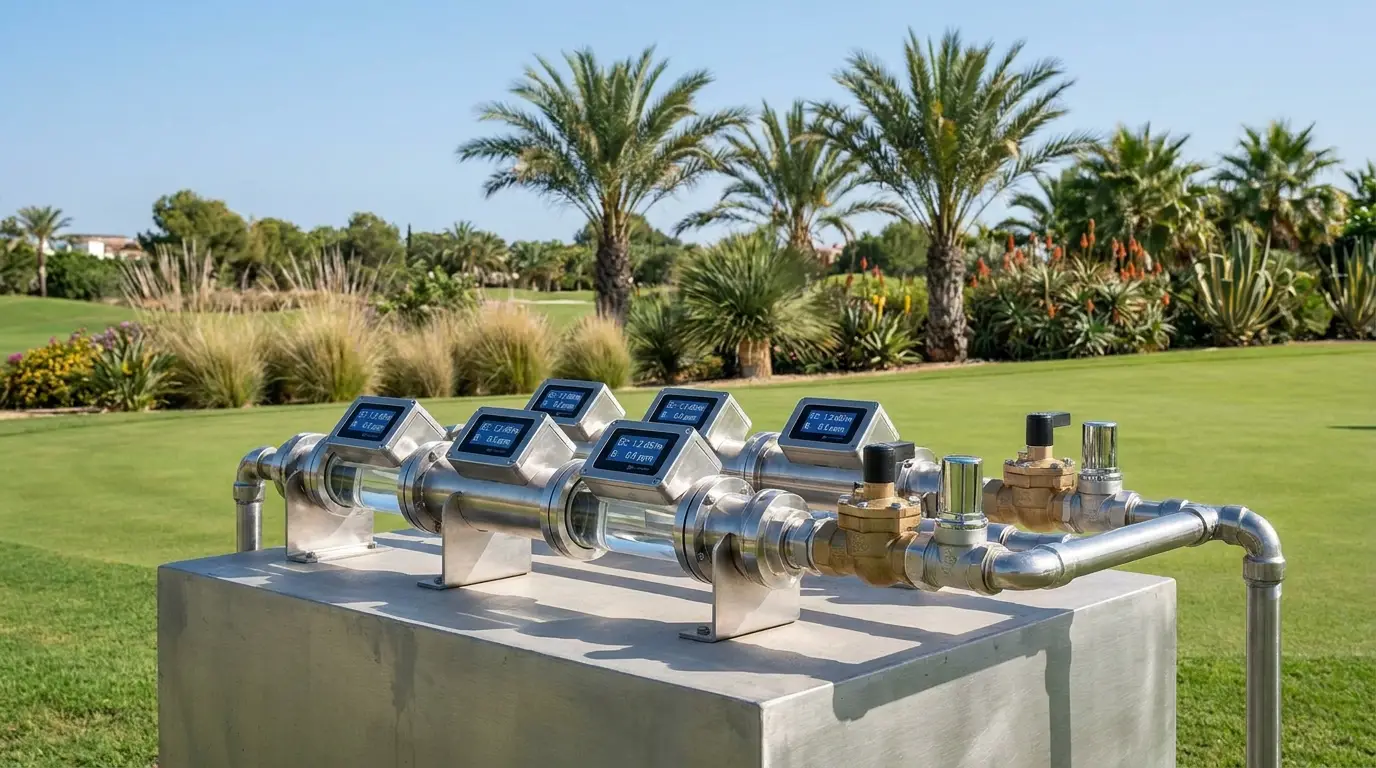
Large-scale residential developments and luxury macro-urbanizations across the Región de Murcia and Costa Blanca are legally mandated to utilize reclaimed wastewater (agua depurada) for the irrigation of their vast communal landscapes. While environmental sustainability mandates drive this practice, the continuous application of secondary effluent is quietly destroying the underlying soil physics and high-value botanical investments of these communities. Presidents and institutional investors are watching premium ornamental zones collapse without understanding the subterranean chemical warfare at play.
The Hidden Cost of Recycled Effluent: Boron Accumulation and Soil Dispersion
Reclaimed municipal wastewater possesses a distinct chemical fingerprint characterized by high concentrations of residual surfactants, bicarbonates, sodium, and heavy metalloids, specifically boron. In the arid, high-evaporation environment of Alicante and Murcia, these elements do not leach naturally; they accumulate exponentially within the upper soil profile. This creates a dual structural and toxicological crisis that standard landscape contractors completely ignore.
The primary structural threat is driven by the Sodium Adsorption Ratio (SAR) of the recycled water. When the concentration of sodium ions drastically outnumbers calcium and magnesium ions in the soil solution, a destructive phenomenon known as structural soil dispersion occurs. The excess sodium ions force their way into the clay lattice structures, pushing the microscopic soil particles apart and completely breaking down the natural soil aggregation.
The Breakdown of Soil Flocculation and Aggregation
As the soil loses its natural flocculation, the structural macro-pores collapse entirely. This transforms the rich substrate into a tightly compacted, completely impermeable, concrete-like layer that suffers from chronic anaerobic conditions. Roots are physically asphyxiated, and subsequent water applications pool on the surface, evaporating uselessly while escalating utility costs for the macro-community.
Simultaneously, the high baseline of boron within reclaimed water presents a severe phytotoxic hazard. Boron is an essential micronutrient, but the margin between safety and lethality is micro-metrical. Because recycled water consistently carries elevated boron loads from household detergents, ornamental plants like Strelitzia nicolai, Strelitzia reginae, and luxury citrus varieties suffer from systemic boron phytotoxicity, manifesting as necrotic leaf margins, premature defoliation, and terminal vascular decline.
The Local Maintenance: Blind Irrigation Scheduling
The community maintenance sector in southeastern Spain is heavily compromised by uncertified gardening companies and low-cost multi-service crews who manage macro-landscapes through primitive, manual labor routines. When these uncertified operators notice pooling surface water, yellowing turf, or scorched ornamental foliage, their unscientific response is always to blame the heat and increase the automated zone runtime.
This thoughtless intervention is an absolute agronomic disaster. Forcing more unmonitored, high-bicarbonate reclaimed water into a dispersed, anaerobic clay matrix accelerates the sealing of the soil surface. The high level of bicarbonates precipitates the remaining natural calcium out of the soil solution as calcium carbonate, locking the sodium in place and permanently solidifying the subterranean compaction. The "chapuza" gardener is effectively petrifying your multi-million euro landscape asset.
The Mechanical and Chemical Disasters of Unmonitored Effluent Use:
- Total Failure to Measure Adjusted SAR: Amateurs ignore the chemical ratio between sodium and divalent cations, leading to permanent loss of soil hydraulic conductivity.
- Bicarbonate-Induced Carbonate Scaling: Allowing un-neutralized carbonates to bind natural soil minerals, forming an impenetrable barrier to root respiration.
- Blind Fertilizer Applications: Adding traditional synthetic fertilizers to high-EC effluent water, which spikes soil toxicity and triggers systemic root-rot epidemics.
- Complete Absence of Soil-Pore Leaching Calculations: Operating irrigation systems without calculating the exact volume required to move boron past the active rhizosphere.
The SERVINMOSOL Engineering Strategy for Effluent Optimization
At SERVINMOSOL, we treat large-scale community irrigation through the strict application of advanced soil mechanics and aqueous geochemistry. We don't just schedule clocks; we engineer automated chemical counter-measures to neutralize the toxic parameters of reclaimed effluent, preserving both the physical soil matrix and the aesthetic prestige of your real estate holdings.
Chemical Flocculation and Gypsum-Based Ion Displacement
To reverse structural soil dispersion and restore the collapsed macro-pores of your community grounds, our technical team implements a precise ion-displacement strategy. We inject high-purity, ultra-micronized liquid gypsum matrices (calcium sulfate) directly into the main irrigation network. The massive influx of divalent calcium ions forcefully displaces the toxic monovalent sodium ions from the clay exchange sites.
The displaced sodium bonds with the sulfate radicals to form highly soluble sodium sulfate, which can then be effortlessly flushed out of the root zone. This chemical substitution completely re-flocculates the clay particles, structurally opening up the soil matrix to restore natural hydraulic conductivity, drainage velocity, and deep-root oxygenation zones.
Automated Acidification and Boron Leaching Vectors
To eliminate the threat of boron accumulation and carbonate sealing, we integrate automated, high-precision sulfur burners or liquid organic acid injection loops into the community's primary pumping station. These systems continuously monitor incoming effluent parameters and inject precise micro-doses to lower water pH to an optimal 6.2 to 6.5 range. This targeted acidification converts destructive bicarbonates into harmless carbon dioxide gas and water, preventing carbonate scaling entirely.
Furthermore, maintaining the rhizosphere at a slightly acidic equilibrium dramatically alters boron speciation. At this controlled pH, boron remains primarily in the un-ionized form of boric acid, which does not bind tightly to clay particles. This allows our agronomists to calculate a highly efficient, targeted leaching fraction profile, successfully flushing the toxic boron molecules down into the deep sub-surface geology, far below the sensitive root zones of your premium ornamental flora.
Sustainable Agronomic Stewardship for Shared Assets
For community presidents overseeing massive multi-phase urbanizations and institutional investors holding large real estate assets, the communal landscape is the primary driver of property valuation and expat buyer attraction. Allowing uncertified, low-cost contractors to ruin these common areas through a complete ignorance of recycled water chemistry is a severe breach of asset protection that leads to massive community assessment costs and dead landscapes.
Agronomic Synthesis and Executive Mandate
Successfully navigating the complex chemical challenges of mandatory reclaimed water irrigation requires rigorous automated chemical injection, precise ion-displacement calculations, and continuous material-science analysis of the soil-water interface. True botanical longevity and structural soil resilience are achieved through advanced technological intervention, not superficial lawn mowing.
Expert Advice: Never allow your community administration to utilize reclaimed water without integrating an automated pH-rectification and calcium-injection manifold at the central pumping station. Demand an immediate laboratory evaluation of your soil's exchangeable sodium percentage (ESP). Contact the elite agronomic engineering and macro-estate division at SERVINMOSOL.COM today to deploy a scientifically validated effluent management protocol for your community assets.