
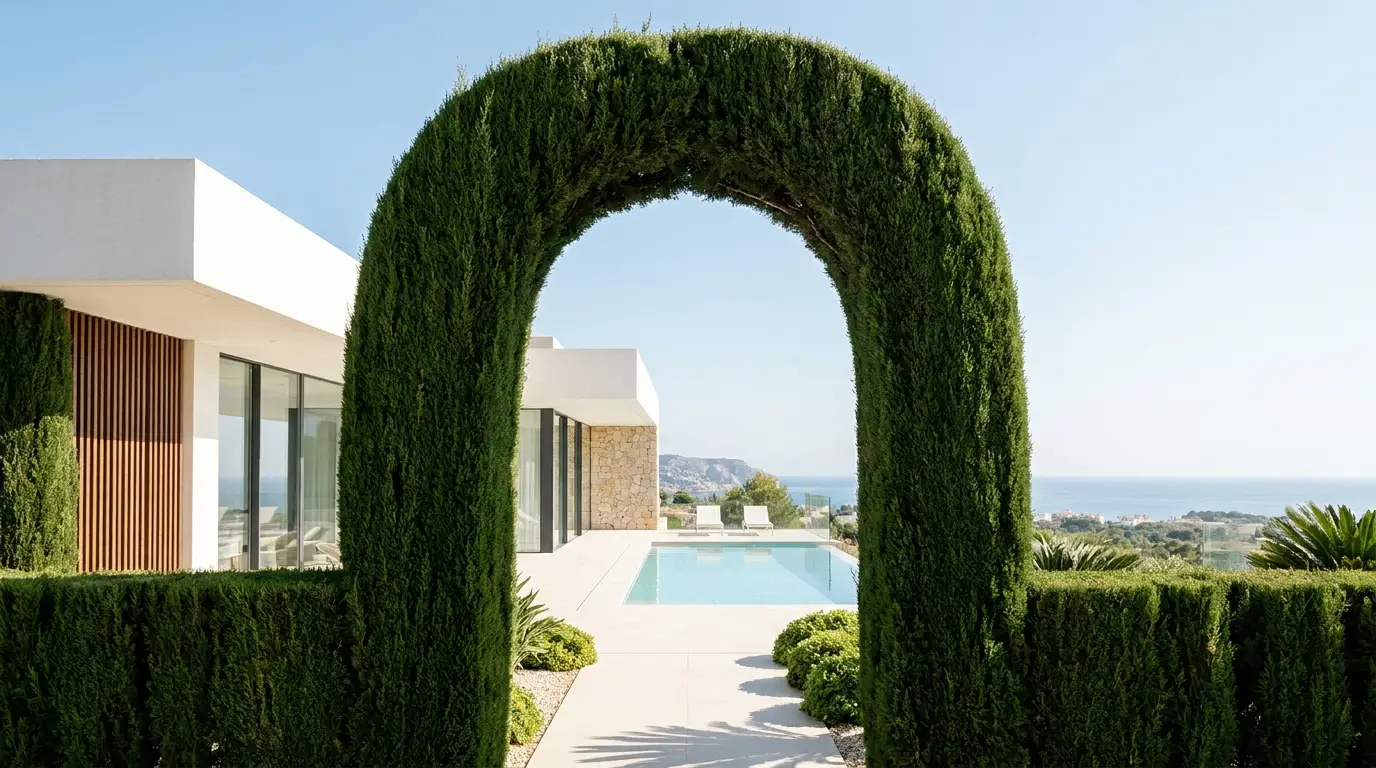
For property owners of exclusive villas and presidents of large-scale residential communities across the Región de Murcia and Costa Blanca, perimeter privacy is a paramount asset. Millions of euros are invested in structural living barriers, primarily using elite cultivars of Cupressus sempervirens (Italian Cypress), Thuja occidentalis, or Nerium oleander. These massive green walls are engineered to provide acoustic dampening, wind mitigation, and absolute security.
However, an environmental crisis is sweeping through high-end developments in Torrevieja, Orihuela Costa, and the open landscapes of Murcia. Hundreds of meters of mature, expensive privacy hedging are showing rapid, patch-like browning, skeletal canopy thinning, and localized branch death. This structural deterioration is rarely a consequence of drought or standard soil deficiencies; it is a direct consequence of systemic vascular assassination.
The Etiology of Hedgerow Collapse: Pathogenic Cankers and Xylem Blockage
The core mechanism driving this botanical destruction is the introduction and uncontrolled proliferation of highly aggressive vascular fungi, specifically Seiridium cardinale (Cypress Canker) and Phytophthora cinnamomi. These phytopathogens do not merely attack the leaves; they penetrate deep into the cambium layer, the vital circulatory system of the plant. Once established, the fungal mycelium colonizes and physically occludes the xylem and phloem vessels.
As these transport pathways become blocked, the upward transpirational pull of water and the downward distribution of photosynthates are entirely disrupted. The plant experiences a highly localized, irreversible physiological strangulation. This manifests visually as the characteristic "flagging" symptom, where individual large limbs turn bright reddish-brown while neighboring branches appear temporarily unaffected, signaling a terminal internal infection.
The Thermodynamic Stress of Coastal Microclimates
In the extreme Mediterranean climate of southeastern Spain, daytime thermal radiation can elevate plant tissue temperatures to critical thresholds. When a living boundary hedge is simultaneously battling vascular occlusion and high evaporative demand, its cellular defenses collapse. The high relative humidity of the coastal salt breeze provides the exact microclimatic conditions required for fungal macro-conidia to germinate and infect neighboring tissues within hours.
The Crime of Intrusion: How Amateurs Annihilate Structural Greenery
The landscaping sector along the Costa Blanca is severely compromised by uncertified maintenance laborers and low-cost multi-service crews. These operators treat high-value botanical specimens with the same blunt, unscientific approach used for clearing roadside weeds. Their complete ignorance of plant anatomy, blade dynamics, and epidemiology transforms routine property maintenance into a vector for estate devaluation.
The standard backyard "chapuza" involves using heavy mechanical gasoline hedge trimmers with dull, improperly gapped blades. Instead of executing clean, cellular-level cuts, these degraded tools crush and shred the woody tissues of the hedge. This leaves a jagged expanse of dead cellular debris and torn cambium that remains perpetually open, acting as a literal open wound for fungal spore landing and immediate colonization.
The Catastrophic Vectors of Incompetent Shearing:
- Cross-Contamination via Dirty Blades: Unqualified gardeners move from one infected urbanization to a premium estate without performing any disinfection protocol on their mechanical cutting gear.
- Absolute Neglect of Tool Sterilization: Amateurs never sanitize blades between individual plants, successfully inoculating every single specimen along a three-hundred-meter perimeter wall.
- Incorrect Pruning Chronology: Executing aggressive structural cutbacks during the peak heat of August or during high-humidity winter rain events when the plant's immune system is incapable of suberization.
- The Blunder of Radial Scalping: Cutting past the green, active meristematic zone into old, non-regenerative structural wood, forcing irreversible canopy baldness and structural rot.
The SERVINMOSOL Engineering Protocol for Vascular Hedgerow Preservation
At SERVINMOSOL, we treat high-value privacy hedges as living architectural infrastructure that requires rigorous agronomic interventions. We do not engage in superficial cosmetic trimming. Our specialized plant pathology division implements advanced chemical engineering, surgical sanitation, and vascular remediation to salvage and fortify your green capital investments.
Phase 1: Advanced Endotherapy and Systemic Fungal Interception
When a mature hedge line is compromised by internal vascular pathogens, surface chemical spraying is completely ineffective, as the active ingredients cannot penetrate the bark. SERVINMOSOL deploys low-pressure systemic vascular endotherapy. We inject targeted, industrial-grade fungicidal formulations directly into the active sapwood of the tree. This ensures the chemical profile utilizes the plant's own transpirational stream to distribute the treatment rapidly throughout the entire canopy, neutralizing the internal mycelium without polluting the surrounding community environment.
Phase 2: Surgical Debridement and Micro-Kinetic Aeration Thinning
Our certified arborists execute precision surgical debridement on localized cankers, removing diseased cortical tissue down to healthy, uninfected cambium. Following the extraction, we seal the wounds with proprietary, copper-infused elastomeric mastics that form an impenetrable artificial barrier against water ingress and spore entry. Simultaneously, we perform strategic internal canopy thinning to modify the structural wind architecture of the hedge.
By removing crowded, stagnant inner branches, we alter the micro-kinetic airflow inside the living wall. This drastically lowers ambient humidity within the canopy shell, eliminating the stagnant moisture pocket that fungal spores require to successfully complete their reproductive cycles. All tools are strictly sanitized between every single cut using high-concentration quaternary ammonium compounds.
Phase 3: Rhizosphere Immunostimulation and Phytophthora Suppression
To address soil-borne threats like Phytophthora, which attack the root architecture in highly compacted or poorly drained soils, we re-engineer the active root zone. We apply targeted drenches of highly mobile potassium phosphonates combined with specialized mycorrhizal inoculants. This dual-action approach triggers the plant's natural systemic acquired resistance (SAR), inducing the production of phytoalexins that structurally fortify root cell walls against fungal penetration while optimizing nutrient uptake.
Maximizing Real Estate Asset Value and Community Separation
For community presidents managing large residential zones and private investors protecting luxury coastal villas, a fully mature, four-meter-tall privacy hedge is irreplaceable in the short term. Allowing unqualified, low-cost laborers to butcher these biological structures results in total hedge death, exposing your property to prying eyes and incurring massive capital expenses for removal, soil sterilization, and replanting.
Conclusion and Technical Directive
Preserving the health and architectural geometry of premium Mediterranean boundary hedges requires strict compliance with advanced plant pathology, precise mechanical shearing execution, and systemic vascular chemistry. Structural hedging longevity is achieved below the bark through scientifically sound, sterile maintenance engineering.
Expert Advice: Never allow any contractor to touch your perimeter hedges without verifying that all cutting machinery is systematically disinfected with professional-grade virucides and fungicides prior to entering your property boundary. Demand a dedicated, proactive phytosanitary plan that outlines vascular endotherapy cycles. Contact the advanced agronomic engineering and elite estate management division at SERVINMOSOL.COM today to secure a technical diagnostic evaluation of your structural living barriers.